
Gili Hoxhaj
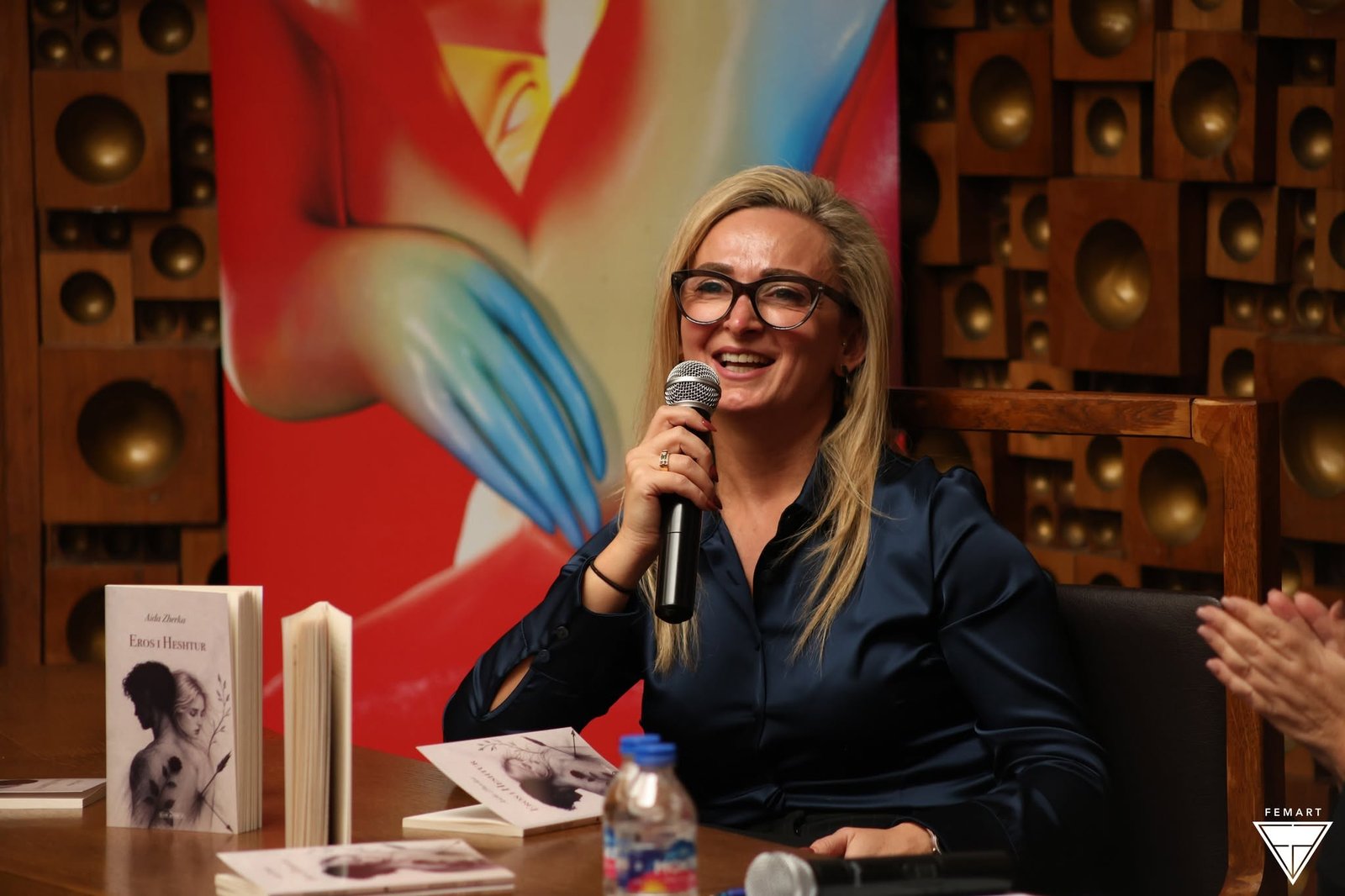
Aida Zherka, who left Gjakova years ago for Luxembourg, returned to Pristina with a book that has carried her longing throughout the years. “Silent Eros” holds within it the years of her youth, her longing for her hometown and for youth itself, for so many things that are no longer the same. For a love that endures and grows.
Her poetry speaks of how, in the eyes of the city, Aida is 17 years old, just as she once was, intoxicated by youth and joy, when every step was another dance. Her return with the book “Silent Eros”, at the Grand Amphitheatre of the National Library of Kosovo, was filled with emotion.
“I left so much love for my city behind and never thought I would return. I get emotional because my people are here; every time I come, I get emotional,” she explained.
Aida Zherka is an Albanian writer and poet from Kosovo who primarily explores sensitive and intimate themes of the human soul, identity, and women’s experiences. Her work received increased attention during its official launch at the 14th edition of the FemArt Festival in Pristina, which this year is being held under the motto “Embrace the Unknown.”
The book launch was moderated by writer and journalist Ilire Zajmi, placing Zherka’s work at the center of discussions on contemporary literature and the role of women in art. She emphasized that Aida Zherka’s poetry collection “Silent Eros” is a journey toward oneself. It begins with distance and the feeling of being held captive by absence, moves through memories, longing, desire, love, and loss, and arrives at a point where the lyrical subject no longer seeks only the other, but begins to seek herself.
“In this sense, the silence of eros is not an absence of feeling, but its deep presence. What remains unspoken becomes part of memory, the body, and the soul. Love in Zherka’s poetry unfolds not only as a relationship with the other, but also as a confrontation with wounds, absences, and personal identity,” said renowned writer Ilire Zajmi.
Through her verses, Aida shows that wherever she has gone, she has folded love into her first suitcase and given it generously to everyone, until today, when she has found the foundation of love to love herself, something she affirmed during the book launch among friends and family.
Her mother also took the floor. She is the first reader of Aida’s poetry and appreciates her verses, but rejects the pessimism in her poetry. Aida says that she writes when she feels pain. That is why, from afar, she has written more.
Aida’s verses speak about women, rebellion, and the unquenchable desire for freedom.
“I have fought against mentality. We have not understood the importance of women, so through poetry I have invited people to understand the importance a woman has within a family. We are the ones who lead the family, and we should be respected more,” she emphasized.
Silence is where we choose to remain silent because we are unable to change things, the part where you swallow everything and let it flow because you have no possibility of changing it. I represent eros, whose silence remains unspoken.
According to the book’s editor, Ilire Zajmi, Aida’s poems can also be read as a return to the point from which a person begins, toward the creation of a new, more conscious and harmonious self, where hope and the desire to live prevail over loss.
“In this sense, the silence of eros is not an absence of feeling, but its deep presence. What remains unspoken becomes part of memory, the body, and the soul. Love in Zherka’s poetry unfolds not only as a relationship with the other, but also as a confrontation with wounds, absences, and personal identity,” she concluded.
FemArt 14 continues its activities until September 30, immersing the public in the unknown with the curiosity of a child and the dreams of women who dare. This was also reflected through another book presented at FemArt.
