
Gili Hoxhaj
A welcome in several languages creates a fierce opening, a dynamic entrance, a promising strike into the world of cabaret. If something in art needs to begin well in order to hold your attention, “Cabaret 1999” achieves this from the very beginning. Everyone seated around elegant tables covered with red tablecloths is asked to leave their worries outside and enter the world of music, dance, humour and happiness. An invitation to discover the authenticity of this happiness. Its shades of light and darkness.
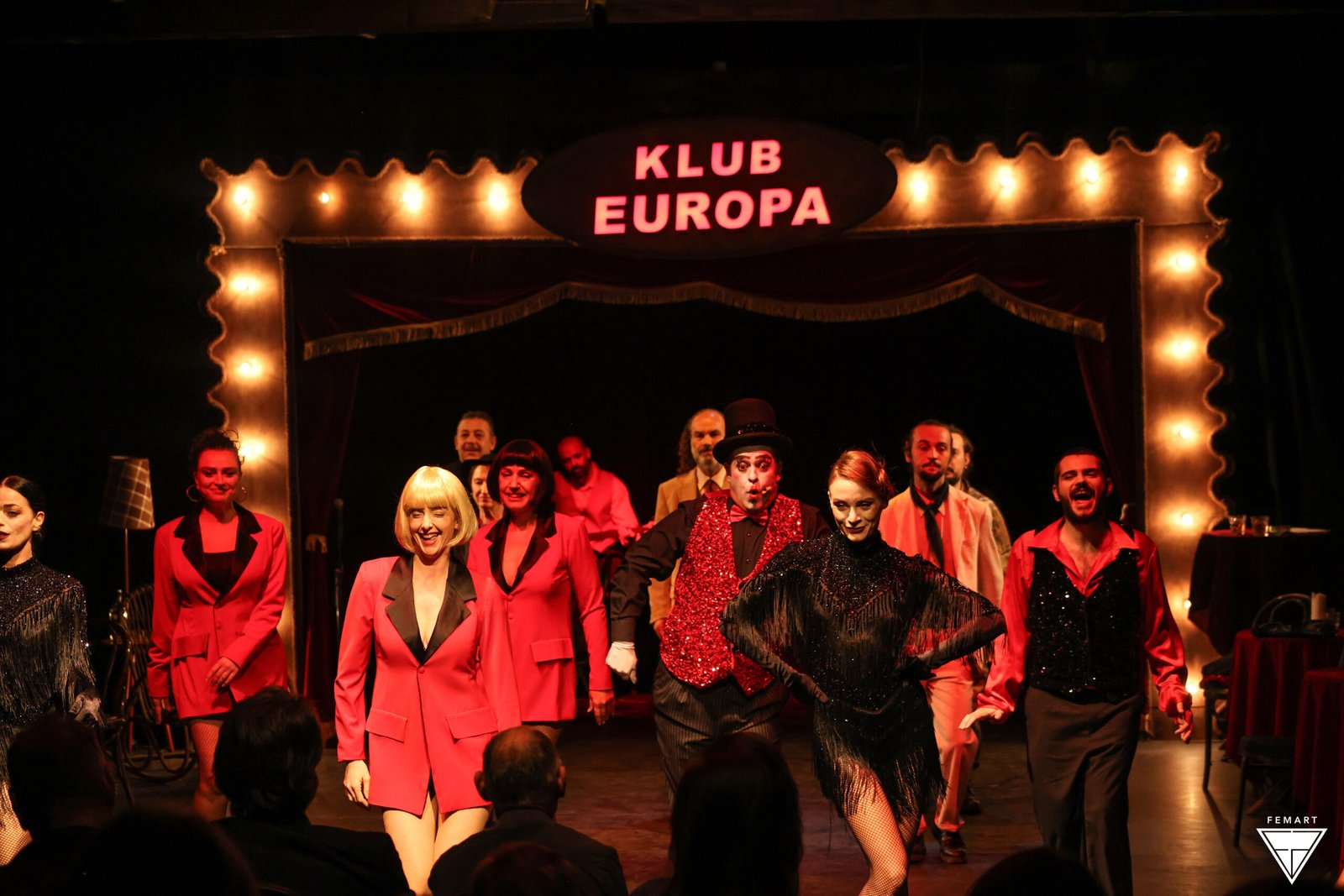
The characters are dressed in red, black and white. They enter a new year where happiness and freedom are still fragile. “Club Europa” will be a club of experiences and strong contrasts. It is the kind of club where everyone who enters comes to have a good time. The girls are introduced one by one. They mainly parade through dance. Some of them are not even heard. They speak, while others make deals on their behalf. The audience melts into the performance from the very beginning of this welcome.
“Cabaret 1999”, directed by Zana Hoxha, which had a successful premiere at the City Theatre of Gjilan in February this year, came to the Cultural Station, which opened on Monday in Prishtina. This is where Artpolis will now focus its activities. Not everything will be a celebration during the approximately hour-and-a-half-long performance. Some loves are born, while some waits never come to an end. Some books are never written.
The performance is set in post-war Kosovo. “Long live the Republic of Kosovo” was once a dream to be shouted out loud. This was manifested in the play of the dreamy young men who now spend their time in music clubs.
Aida Lara is introduced as a girl from Skopje who has brought with her a suitcase and her dreams of writing a new book in Prishtina. About the fate of a mother who waits. Aida will become a name that will be mentioned often later on. Somehow, she disrupts the life of the club. She looks deeper.
She will become the barmaid of an Italian owner, Claudio, who later expresses his love for her by saying, “I am different from these people here; when I say something, I keep my word” – and claims that he sees her in the depths of her soul, not as men see women in the club – as bodies that are forgotten after one night.
Dudija waits for many soldiers in her room. Afërdita, who is the hostess of the rooms where they stay, observes and grows resentful, until another meeting with Agim, with whom she will rekindle the flame of love that eventually leads to a marriage that ends with his death from revelry.
The performance features Semira Latifi as Aida, the central character; Kushtrim Qerimi as the MC; Edon Shileku as Soni; Gëzim Bucolli as Ernesti; Aurita Agushi as Afërdita; Safete Mustafa Baftiu as Dudija; Gani Rrahmani as Claudio; Ali Demi as Agim; Mejreme Berisha as the Woman Searching for Her Son; and Blend Arifi as the Soldier. The performance also features dancers Aulonë Nuhiu and Jeta Musolli, while the original music and songs are by John Kander and Fred Ebb, with orchestration by Liburn Jupolli.
“Cabaret 1999”, directed by Zana Hoxha, is a musical performance that shifts the story from 1930s Berlin to Prishtina in 1999 – a city that has just emerged from war and is learning to live again, amid hope, exhaustion and a desire for life.
Post-War Prishtina – A City Where Anything Can Happen, Just Like in a Cabaret
Prishtina at that time, as the performance also shows, is a city where anything can happen. With this performance, director Zana Hoxha manages to untangle the threads of the reality of that time. She brings out all the threads in their own colours. It is this tangle that has shaped reality for so many years.
In the cabaret, at the end of the day, everyone is struggling for a little more money in order to survive. Amid celebrations and desire, conversations sometimes become heavy. The electricity suddenly goes out. It happens so naturally that it is impossible to tell whether it is part of the performance or reality. Even 26 years after the war, the electricity can still go out. Anything can happen in Prishtina, even today.
The audience is asked to light candles. Director Shqipe Malushi comes from America every year to attend the “FemArt” festival. She writes that Zana Hoxha, together with Artpolis, are guides for artists, always finding another door to open and inviting the community to walk through it, and that this was a wonderful way to close this edition.
“Zana has a rare gift for finding light without turning away from darkness. She placed the story in Kosovo in 1999, where a mother searched for her missing son and a lack of electricity could suddenly plunge a room into darkness. Even there, people found ways to laugh, to love and to dream of tomorrow. Under her direction, every burst of laughter seemed to hold a little of our history inside it,” she wrote.
Shyhretja, the woman who is still searching for news of the son who was taken from a column, still has the candle of hope burning. She describes her son, Fatbardh, as a boy who healed people through song.
“You’re going to find my son for me,” her call and her hope are a different kind of reality. She hopes that he will return not only for her, but to bring joy to everyone’s soul with his songs. A woman had stopped crying when she heard his voice at a funeral.
“I have started to love dreams. I see him every day, I hear his sweet voice. I will continue to search for Fatbardh,” she says.
A broad-shouldered man has long been deceiving her with answers that she cannot even make sense of. He offers her the strength of his body in exchange. Because, as the performance says, even the missing become the subject of secret deals. Even their names.
As the performance states: Someone buys silence, someone buys the truth, someone sells lies, and someone acts as their intermediary.
Director Zana Hoxha has described 1999 as a particularly personal period for her. She remembers that time as a mixture of emotions: the joy of newly gained freedom, but also the pain, uncertainty and chaos that were still present. Prishtina, meanwhile, was trying to breathe again.
People needed to go out, listen to music, fall in love, celebrate and start life over. There was an enormous thirst for life. But the end of the war did not mean that its wounds had disappeared. That is why she chose precisely that period.
“Entire families lived between hope and waiting, without knowing what had happened to their loved ones. And the issue of missing persons was not only a personal tragedy – it was and continues to be a deeply political issue, an unhealed wound of the war.
At the same time, after the war, another dark reality emerged: the trafficking and exploitation of girls and women. This happened in a society that already had a strong patriarchal mentality. For me, it was very important to look at that period through the eyes of women as well, because very often we have told the story of the war and post-war period through men, while women’s experiences have remained on the margins.
This is how I remember that time: there was freedom and joy, but there was also a great deal of pain, injustice and things we did not talk about. And it was precisely from this contradiction that KABARE 1999 was born for me,” she said.
“Even in the Most Difficult Times, People Have Laughed, Fallen in Love, Listened to Music, Danced and Made Jokes” – Zana Hoxha
In this performance, Zana Hoxha raises more questions than she gives answers. We manage to laugh, to sing Dudija’s song and then return to a painful scene and watch it with solemn faces. The performance takes you from one scene to another without making the transition obvious, without making you feel guilty.
This was also the director’s intention. She says she did not want to create a heavy performance about the war, where the audience knows from the very first minute that it is supposed to feel bad. She did not want to portray women only as victims, but as individuals and characters who have desires, sexuality, humour, anger, dreams and an extraordinary strength to move forward.
“Because life was not like that. Even in the most difficult times, people laughed, fell in love, listened to music, danced and made jokes. Especially after the war, there was an extraordinary need to live. I remember that energy. That is why live music, humour and cabaret are not decoration in the performance. They are part of the history and of the way these people survive.
The audience may be laughing or enjoying a song and, a moment later, find itself confronted with the disappearance of a person, the trafficking of a girl, violence or the patriarchal reality of that time. That contrast is precisely what interests me. Humour does not diminish pain. On the contrary, sometimes it makes it even stronger,” she continued.
Aurita Agushi, in the role of Afërdita, personifies a strong woman. A woman whose eyes still sparkle with love. A woman who gives a little of the warmth of home to everyone – through reprimands, respect, hospitality and everything else.
This is how she welcomes Aida, whom she introduces as a “professor”; this is also how she reprimands Dudija. She has a presence and embodies the role in a way that turns her into a lonely woman, a woman who runs after love and a woman who keeps the home together.
Aurita has said that she built the character beyond the text, trying to see her as a real human being, with her own history, wounds, desires and strength. What brought her closest to the character was precisely her human side – the ability to find the strength to live, love and preserve her dignity even in the face of hardship.
“The greatest challenge was finding the balance between humour, music and the pain of a time that is still very much alive for us. Making the audience laugh without losing the weight of what happened requires a great deal of sensitivity. For me, ‘Cabaret 1999’ is precisely that fine line where laughter and pain coexist,” she said.
Zana Hoxha does not want to give the audience ready-made answers, but rather make it part of the experience of the performance. Through humour, music and the energy of 1999, she invites the audience to reflect on what happened after the war: what kind of society we began to build, what happened to women, the families of the missing, and the wounds that continued to remain.
For her, “KABARE 1999” is not nostalgia, but a way of looking at the present through the past and asking ourselves how much we have changed.
Life is a cabaret. Come to the cabaret! This is what the performance says. Life truly resembles this cabaret, where you fall and rise again, where you search for and hide the truth. This performance makes you feel sad and laugh, without making you feel guilty for either. Both must be lived in their own moment, in their fullness.
