
By Gili Hoxhaj
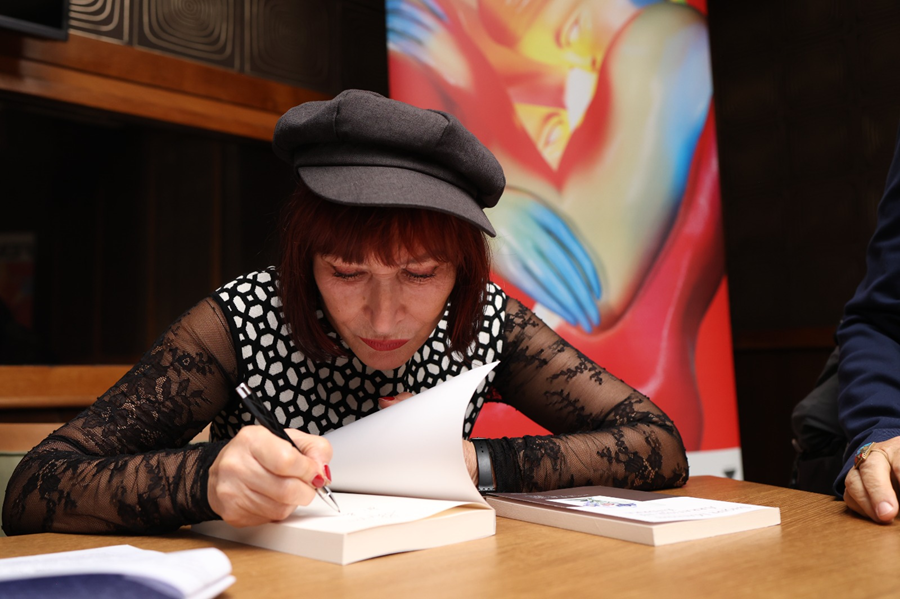
“We will embrace the unknown.” This is what the writer who moderated the event, Ilire Zajmi, told us shortly before the promotion of “Love in the Time of Communism”, the book by writer Besa Myftiu. And that is where the embrace of her book began — through stories of love, taboos, and truths about loves that no regime can defeat. The audience embraced the stories of her characters as if they were their own. Questions and comments from the audience revealed a genuine curiosity about the book.
“Love is always resistance. Love is a way of resisting oppression. Only the one who loves finds a way not to obey. Love is strength,” the writer said, among other things.
Besa Myftiu is an Albanian writer, poet, and essayist, known for her writings on love, life, identity, and the human experience. Born in Tirana and based in Geneva for many years, she writes in both Albanian and French, bringing a unique perspective shaped by two cultures.
At the center of the book are three women — Anila, Diana, and Monda — who meet during a night of waiting at Fiumicino Airport and share their stories of love during communism. One returns from America, another from Rome, and one from Paris. A bottle of wine opens chapters of their lives, revealing the taboos that shaped life in communist Albania.
The book, in itself, speaks about freedom. About freedom from what we have lived through, from the past. They speak about different taboos, and about relationships shaped by family, age differences, and a social system.
Besa Myftiu returned after ten years for a meeting with readers from Kosovo. She spoke about the story of Anila, who had fallen in love with Mujo Bajraktari from Ferizaj. It was a love story interrupted halfway. But for Anila, the struggle for that love never ended. After a long and exhausting search, she eventually gave up looking for Mujo and continued her life in Paris, studying linguistics.
Mujo, too, had remained persistent in this love. He did not give up, even years later, after rebuilding his life between prison and freedom.
Years later, his phone call began with this sentence: “Do you remember that the first love is also the last?” He told her about his marriage, prison, poems, and reading newspapers, until he found Anila Kraja through the French Embassy, while Anila herself had almost turned earth and sky upside down to find him.
Mujo briefly told her that the State Security had forced him to leave and that he had written many verses while in prison. The passing years could be seen in his poetry.
As author Besa Myftiu explains, Anila had been left in a desert of emotions.
“I tried to love Europe, but I had given all my love to Kosovo.”
At that time of war, Kosovo had become the epicenter of the news. The population of Tirana had quadrupled. All of this became clear through a reading performed by the author herself.
Myftiu went on to explain that love during communism had the scent of a dream. Imagination was easy, but reality was difficult. The hardships and the person they met became the prince of their dreams, a way of holding on to those dreams. Love could not be fulfilled because the obstacle was either family or society.
“Literature is a way of sublimating the past. I think that, in our tragedy, we have found the strength to make humor. Perhaps it is Balkan, but especially Albanian,” she said.
The heroines of this novel triumph over pain, the author continued, describing a book that brings tragedy and comedy together.
“In this book, I have tried to give meaning to the past, in which the future takes shape,” she emphasized.
When asked how much reality may have changed since then, Besa said that 30 years is a very short time to change a mentality, even though laws can change.
The book promotion also included music by Elina Duni, presented in audio. It was a moment of emotion between words that recall and bear witness to a great truth, as the book reminds us that the greatest revenge is happiness.
And another truth: no regime can prevent love.
