
Gili Hoxhaj
The meeting point was the “Newborn” monument. The yellow bus, so familiar in the capital, was packed from end to end with art lovers. “FemArt 14” always aims to leave its audience with a different kind of memory, a different experience of the journey leading to the performance. A journey through words, acting and music that touches you. As we left the cinema and took our seats on the bus, conversations about the dynamic programme continued, alongside reflections on the previous evening, the feeling of the Cultural Station, and the excitement of what was yet to come.
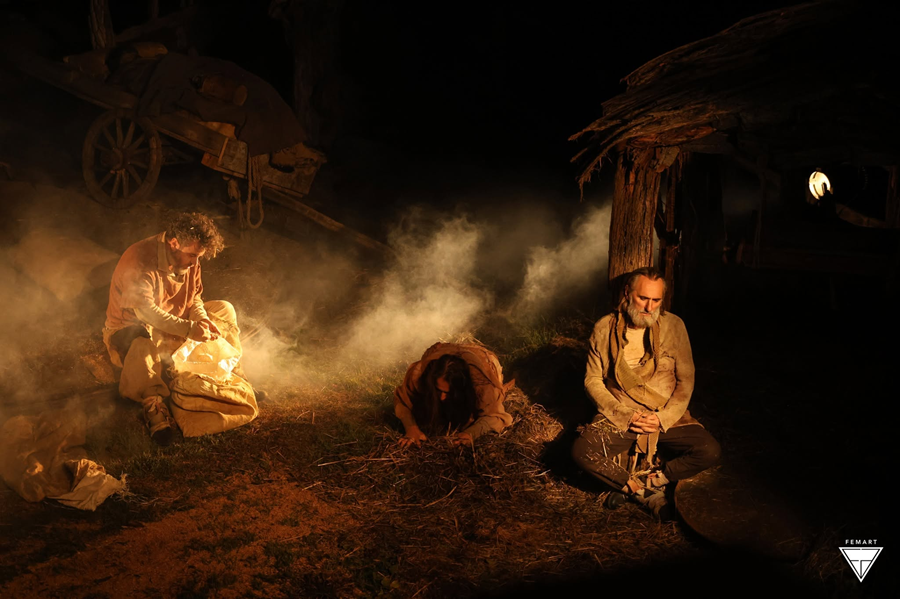
The stop was in Kukaj. Together, we walked until we met the rest of the audience. The road to the stage led downhill. Step by step, we followed one another. And what came next felt like stepping into a fairytale. SERPENTINE was a world of its own. Everything had been carefully woven together into a landscape that remained visible even when darkness concealed the beauty of nature. The lights, the water, the seats, the passage from one space to another – each became a path through memory, an opportunity to experience. Here lies the power of a stage that draws you into the abandoned village of the play, allowing you to live alongside the characters in a place that feels, at times, almost mythological. “Karrocë n’Ajr” offered another embrace of the unknown at FemArt.
Music served as a guide leading the audience towards the stage. The audience took their seats below the stage and on the upper level. A cart placed in the middle would carry more than sacks of grain. It would become the final resting place of a dead man.
A father and his son set out to bring Hana, the bride, home. Their journey is interrupted. The two find themselves in an abandoned village, with no sign of life. The houses, resembling huts, are empty. There are no signs to guide them. Father Gjergj Berisha, played by Mensur Safqiu, awakens from a dream filled with messages; at least there, he had witnessed both sunrise and sunset. Now, he was in the middle of nothingness.
Their path is blocked by a murdered man. A body they cannot simply pass by. As Gjergj says, life has stopped in the man’s eyes. He hopes that if those eyes had been open, he might have recognised him. “What if he saw the murderer in his eyes?” is only one of the many questions he struggles with. He does not know what to write on his epitaph. He insists that he cannot bury him without an identity. He sees this as a human duty.
In these moments, human dignity comes to the foreground – the sense that life has placed this lifeless man before him for a reason. To test his courage. He has no right to bury him, because that right belongs only to the family. “If no one recognises him, when I take him from house to house, I will take him to the highest peak of the mountain,” he says.
His son insists that they continue their journey, where Hana is waiting for them. He argues that while his father is keeping a promise to a dead man, he himself has made a promise to a living one.
Everything is intensified by visual elements and music, making the story even more dramatic. Written by Arta Arifi and directed by Ilirjana Arifi, the performance features Mensur Safqiu, Andi Bajgora, Shpëtim Selmani, Qëndresa Loku, Igballe Qena and Albana Gashi. The music and composition are by Memli Kelmendi.
The playwright, Arta Arifi, says that as an author, she feels the need for her voice not only to be heard, but also to communicate through imagery.
“As an author, I need my voice to be heard, but also to be seen, because I believe drama as a genre is secondary, but becomes primary when it is put on stage. This is why I believe I owe it to this place, to these women, and to myself, for my voice to be heard by others. I am genuinely very intrigued by neuroscience; I like the recreation of memories across different periods of time. I have read about it for quite some time and thought that, with a drama like this, it would be very important to incorporate precisely these elements of reconstruction.”
“I gave my word to a dead man, and I do not break my word. Forgetting is heavier than death,” Gjergj says, his words becoming heavier after the silence between them.
They encounter a girl who has willingly stopped at the ‘stop’ of life. Something greater than suicide always happens to her. Gjergj asks her to confirm whether she knows the dead man, while she remains detached, having watered the entire ground for two days and nights in order to bury her mother beneath the tree in her yard.
Another man, for a piece of grain, offers a lie in exchange for wheat, reasoning that hunger is evil. “Everything that is born from the earth returns to the earth the next day,” he says.
Amid so many questions, when a stranger becomes greater than any other decision, the performance speaks of the inner self, of doubts and resilience. Of principles. Of loss and acceptance.
“I ruined my son’s wedding for the promise I made to a man. What kind of man am I to interrupt the wedding journey?” These are some of Gjergj’s dilemmas.
“This drama is first and foremost about acceptance, before finding someone’s murderer. As an author, I did not want this drama to revolve around lengthy dialogues about a father searching for a murderer. For me, it was more important to take elements from neuroscience and place them within this drama, to understand that it is very important for an individual to have acceptance within themselves of what has happened. I believe that people’s losses are very important, and I don’t think anyone has portrayed them in the way I have tried to portray how an individual can confront the death of someone,” Arta said.
The son, who was on his way to get married, stops for another woman. They find joy in a few moments together. He begins to change. “Karrocë n’Ajr” shows how a place can change a person when they remain there for too long. A cart in the air would hold me in the sky like a god.
SERPENTINE is not simply a venue where cultural events take place. With three theatre spaces, permanent artistic and sound installations, the “Emotional Museum,” the “Houses of Memory,” the “Memory Aquarium,” and an artistic residency programme, it creates conditions for art to be born, developed and presented in the same place.
Activist Valdete Idrizi was among the audience who experienced this space together with the performance. For her, “Karrocë n’Ajr” remained an experience that leaves you speechless.
“Not simply a performance that you watch, but an experience that you live through. The brilliant acting, the extraordinary stage, the music and the magical space of Serpentine in the village of Kukaj came together as one extraordinary whole. A performance, or rather an experience, that does not end with the applause, but continues to stay in your mind for a long time,” Idrizi said.
In those few moments, even the audience no longer cared about finding their way. Serpentine has a kind of magic that does not let you go easily. It keeps you there and does not let you wander anywhere else – not even in your thoughts.
